

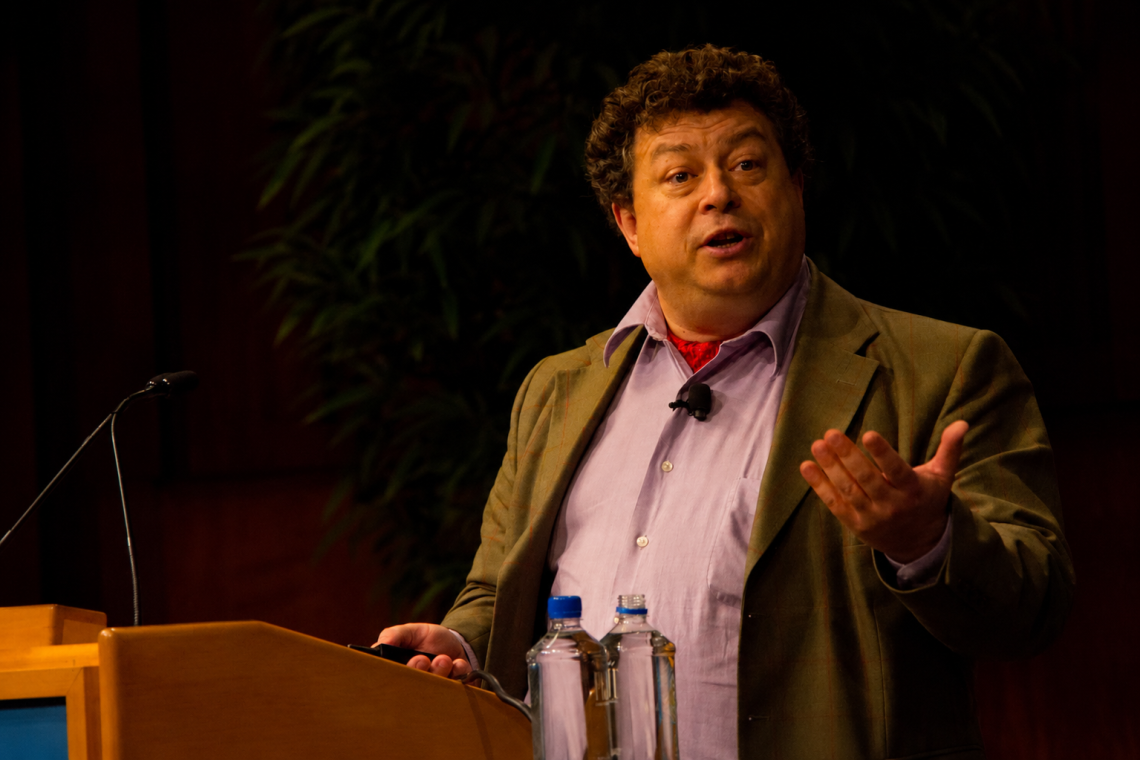
Nine years after his first appearance, Rory Sutherland — Vice Chairman of Ogilvy UK, author of Alchemy, and one of advertising's most quoted contrarians — sat down again with Shane Parrish for The Knowledge Project, the long-running interview series from Farnam Street. The first conversation happened back when podcasting "wasn't even a thing," as Sutherland put it — episode 16 or so, in an era before the medium had found its audience. Nine years and hundreds of episodes later, the second conversation picks up where curiosity about human decision-making tends to lead: straight into the gap between how economists, technologists and consultants think people choose, and how people actually do.
The result is a wide-ranging playbook on three things every marketer is currently wrestling with: what AI will and won't change about choice, why "efficiency" is so often measured in the wrong currency, and which very ordinary business decisions — a call centre, a doorman, a follow-up phone call — turn out to carry disproportionate marketing weight.
AI and Decision Making
Sutherland's starting provocation is aimed squarely at the current AI narrative: the assumption that you'll simply tell an assistant "find me a skiing holiday" and it will hand back the one, perfect answer. His objection is not technical but psychological — humans don't decide that way. At minimum, people need to see three, four or five options before they can choose at all, because, as he puts it, "we can't really choose in the absence of comparison." Preference, in his view, is relative before it is absolute.
He backs this with a small, telling piece of evidence: almost nobody has ever clicked Google's "I'm Feeling Lucky" button, which skips the results page and takes the user straight to a single answer. People, it turns out, want to choose from a visible set of options — not be handed a verdict. Real estate agents already exploit this instinct deliberately, showing buyers a slightly worse, slightly pricier house first so that the property they actually want to sell benefits from contrast (a version of the well-documented decoy effect in behavioural economics).
The open question Sutherland leaves marketers with: what interface will AI settle on to help people choose, and will it repeat the mistake that comes naturally to anyone with an economics or engineering background — assuming customers are tidy utility-maximisers rather than comparison-driven, context-sensitive decision-makers.
The Traps of Efficiency. Efficiency versus Effectiveness
The second thread of the conversation is a caution against how businesses define — and pursue — efficiency. Chasing efficiency, Sutherland argues, tends to pull attention toward numerical and mechanical factors while quietly discarding the psychological ones, even when the psychological factors are where the larger gains are hiding. The practical result: companies over-invest in cost reduction and under-invest in value creation.
The Doorman Fallacy
His now well-known illustration is the Doorman Fallacy: a five-star hotel is told by a consulting-and-tech duo that its doorman — defined narrowly as "someone who opens the door" — can be replaced by an automatic door and an infrared sensor, saving tens of thousands a year. The consultants collect their fee and leave. Two years later the hotel's rates have collapsed, because the doorman was quietly doing a dozen other things the job description never captured: providing security, hailing taxis, handling luggage, recognising regular guests, and signalling status to everyone who walked in. None of that value shows up in a cost model built around a single, literal function.
Sutherland ties this to what he calls the "gain-share" incentive structure common in management consulting, where a firm is paid a percentage of the cost savings it identifies in year one — a model that rewards visible cost-cutting and has no mechanism for pricing in the value that quietly disappears.
"Any idiot can cut costs. What takes real skill is cutting cost in a way that doesn't destroy value."
Marketing Best Practices Examples
The interview is full of concrete cases where a business chose the more human, apparently less "efficient" option — and won because of it.
Why Dyson Is So Effective — Not at Advertising, at Marketing
Sutherland is careful to draw a line: what makes Dyson work, he argues, isn't its advertising but its marketing and customer experience — advertising being, in his words, "a subordinate part of marketing." The example he returns to is the call centre. Rather than automating it away, one very senior person at Dyson insisted on keeping call centres deliberately smaller but staffed by genuinely skilled people, on the logic that no algorithm can substitute for a human in unusual problems, special circumstances, or situations that call for empathy and the authority to simply override the rulebook and do the sensible thing. His broader recommendation to clients across 36 years in advertising: take 10–20% of the marketing budget and put it into upgrading the call centre — pay the best people enough to keep them, because a consistently good human interaction "drowns out all the other noise" in how a brand gets trusted.
Brand Quake: Dyson and the Private-Company Advantage
Sutherland tells the story of his own father, a frugal man who nonetheless owned three or four Dyson machines — one per floor. His theory: Dyson's advantage comes partly from being privately owned, which frees it from the short-term, quarterly optimisation that pushes publicly listed companies to behave, in his words, like they're "optimised around short-term transactional value, not long-term relationship building." He introduces the idea of a "brand quake": a moment where a business solves a customer's problem unusually well, then goes a step further — calling back afterwards just to confirm it actually got fixed. Small gesture, disproportionate trust dividend.
The Cold Beer Thought Experiment
Borrowing a scenario associated with Richard Thaler, Sutherland walks through a simple test: you're thirsty on a beach and a friend offers to buy you a beer from a shop down the road. You're asked, in advance, the maximum you'd pay — once from a rundown shack, once from a boutique hotel — even though you'll drink the beer back on your towel either way, with no exposure to either venue's ambiance. People consistently name a higher price for the hotel-sourced beer, despite identical utility. The lesson for marketers: how good a transaction feels shapes willingness to pay just as much as the product itself does.
The Secondhand Car and the Vicar
A companion example from his book Alchemy: a buyer inspects a used car parked outside a stranger's house, then rings the doorbell. If a tidy, respectable figure — his example is a female vicar — answers, buyers tend to raise what they're willing to pay by roughly 20%. If the door is answered by someone in his underpants, buyers devalue the same car by $1,000 or more, sometimes walking away entirely. Sutherland's reading: buyers can't verify the car's mechanical honesty, so they substitute a question they can answer — do I trust this seller? — and treat that as a proxy for the one they can't. Trust, in other words, isn't a soft add-on to a purchase decision; for most people it is the decision.
Big Marketing Lessons
How to Write Good Copy
Asked to distil decades of copywriting into rules, Sutherland treats it partly as a tacit skill — "we know more than we can tell" — but offers a working set of principles nonetheless:
- Write more conversationally than instinct suggests; most people over-formalise the moment they think they're "writing."
- Prefer verbs to adjectives, and adjectives to adverbs; prefer plain Anglo-Saxon words to their Latinate equivalents, without overdoing it.
- Convert a feature into a benefit rather than stating the feature alone.
- Write mostly plainly, but drop in an occasional, deliberately elevated word — a trick he credits to David Ogilvy — as much to flatter the reader's intelligence as the writer's.
He points to Arthur Conan Doyle's Sherlock Holmes stories, written in the 1880s, as a model of clarity that still reads effortlessly today — proof that clear, plain prose doesn't age the way stylistically "clever" writing does.
Feels-Like Temperature: Solve for Psychology, Not Just the Number
Sutherland borrows the American "feels-like" temperature — which factors in humidity and wind, not just the thermometer reading — as a model for how businesses should define problems. His point: don't define an objective meant to serve human beings while ignoring the psychological variables that actually determine how it's experienced. Often the cheaper, faster fix is to change the psychology of a situation, not the technology behind it.
Two Strings to Your Bow
He's equally direct about a mistake he says "all creative people have made": dismissing rational, data-driven analysis as unnecessary because creativity is what really matters. His view is the opposite of either/or — creative and rational thinking are complementary tools, and the data-driven approach should inform decisions without being allowed to crowd out imaginative ones. As a closing example, he describes advising a friend not to optimise a house search around what everyone else wants, but to look for a feature most buyers avoid — proximity to a pub, or a railway line — that happens not to bother them personally: an arbitrage on other people's psychology, not just their spreadsheets.
Sutherland's closing note ties the whole conversation together: his frustration isn't with accountants, lawyers or economists doing their jobs, but with the outsized power those disciplines have accumulated over decision-making that, in his view, they have no exclusive claim to understand. For marketers, that's the real playbook here — not a rejection of data or efficiency, but an insistence that the psychological, human side of value creation gets a seat at the same table.
Continue the conversation in person
Rory Sutherland's argument, that the psychological side of value deserves a seat at the same table as the numbers, raises questions we'd rather debate face to face than just read about. How will AI shape the way people choose? What are we losing when we optimise for the wrong kind of efficiency?
On 12 November, the Creativity4Better conference organised by IAA Romania brings together the Romanian marketing and advertising community at Face Convention Center. Find out more and make sure you secure your seat by registering in advance here.
