

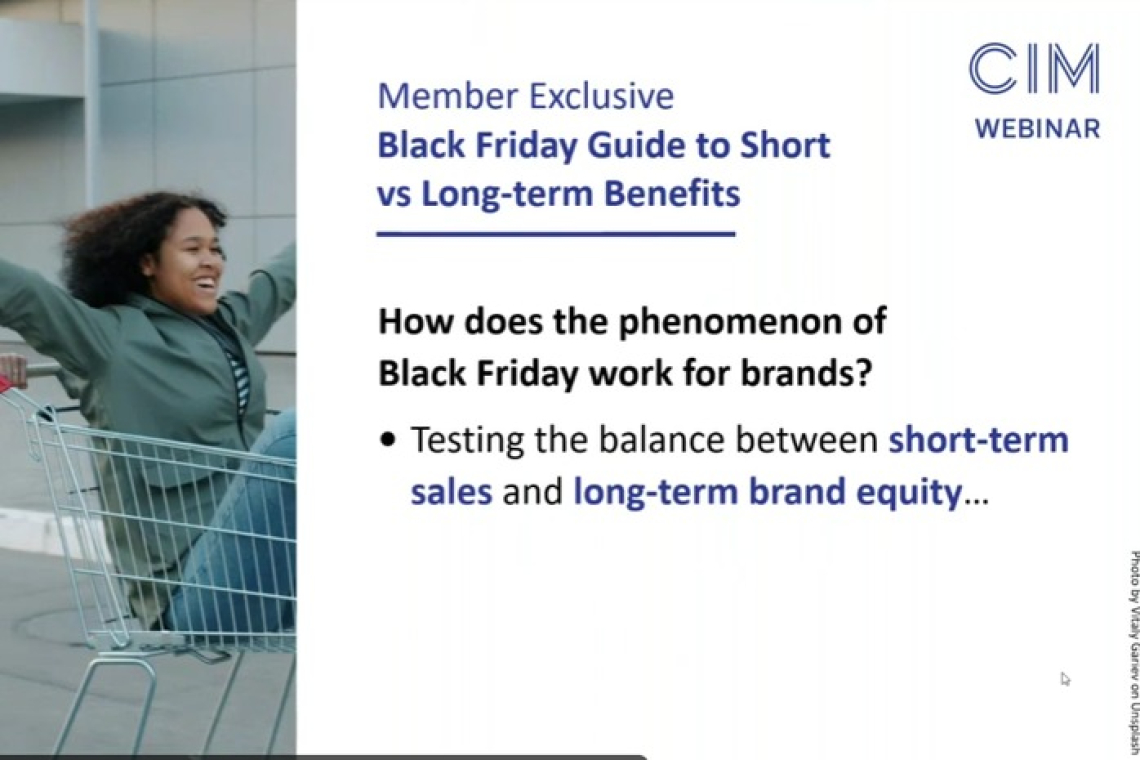
Black Friday is a moment where short-term activation collides with long-term brand building. An evergreen CIM masterclass by Paul Hitchens examines what the day really tests: not the pricing strategy, but the brand itself.
With Black Friday 2026 on everyone’s agenda this November, marketing teams are once again weighing the same question: participate or not and on what terms?
In a member-exclusive webinar for the Chartered Institute of Marketing (CIM), Paul Hitchens FCIM — co-founder of the creative consultancy Verve Brand, CIM Course Director since 2011 and TEDx speaker — offers a structured answer. His framing is deliberately strategic: Black Friday is less a sales event than a "brand performance test under pressure", and its true cost or value only becomes visible over the long term.
The session, delivered ahead of last year's peak season, remains fully relevant. Its argument rests not on seasonal data but on the classic models of marketing — McCarthy and Kotler, Ries and Trout, Sharp, Ritson, Aaker, Binet and Field — applied to one of the most hyped and most misunderstood moments in the retail calendar.
A brand audition, not just a flash sale
The commercial case for Black Friday is real. Hitchens cites Reuters data showing that British shoppers spent £3.63 billion online over the 2024 Black Friday–Cyber Monday period, up 5.2% year on year, while Barclays recorded a 9.5% rise in Black Friday transactions across online and physical retail.
The more interesting figure, however, concerns what happens after the purchase. According to Mintel, 84% of UK consumers say a positive Black Friday experience would encourage repeat purchases — and ease of navigation, delivery and customer service increasingly matter as much as the discount itself. Hitchens' reading is that the day functions as an audition: a test of retailer reliability that can convert bargain hunters into loyal customers, or confirm their doubts.
The reverse is equally true. KPMG research indicates that more than half of UK consumers would walk away from a brand that misleads on sustainability. In a period of heightened environmental awareness, Black Friday's high-consumption model :; fast shipping, overproduction, packaging, places brand claims under particular scrutiny.
Black Friday’s Brief History. A name born in crisis
The history is itself a lesson in rebranding. The term was first used in 1869, when speculators Jay Gould and James Fisk attempted to corner the US gold market, triggering a crash. Its modern usage dates to 1950s Philadelphia, where police used it to describe the chaos between Thanksgiving and the Army–Navy football game. Retailers tried and failed to rename it "Big Friday" in the early 1960s; only in the 1980s was it reframed as the day stores went "into the black".
The marketing mix under pressure
Hitchens returns to the 4Ps — introduced by E. Jerome McCarthy in 1960 and popularised by Philip Kotler — as a diagnostic tool for evaluating short-term activation:
• Product: Black Friday is about what a brand spotlights, not only what it sells. Hero products, limited editions and curated bundles create urgency, but the product must reinforce positioning; deep discounts on core lines can erode a luxury brand's prestige.
• Price: the most visible lever and the most dangerous. Excessive discounting trains customers to wait, a risk Byron Sharp has long warned against.
• Place: no longer a location but a platform. A frictionless omnichannel experience is now a basic requirement, and channels must remain scalable under peak demand.
• Promotion: where creativity meets strategy. Countdown campaigns and gamification can cut through, provided they reinforce the brand's codes of tone, visuals and language.
For service-led brands, the extended 7Ps of Booms and Bitner (1981) add depth: People (is every team briefed?), Process (the make-or-break element of the customer journey) and Physical evidence ("the theatre of trust", from packaging to digital UX). Hitchens' suggested use: the 4Ps to critique short-term activation, the 7Ps to explore the long-term brand experience.
Positioning: the battle for the mind on the noisiest day of the year
Drawing on Al Ries and Jack Trout, Hitchens frames Black Friday as a battlefield of competing offers in which positioning is the means of standing out. On the classic cost-versus-quality grid, the low-cost, low-quality quadrant attracts deal hunters but earns little loyalty, while premium brands may resist deep discounts to protect equity. The most interesting option sits off the grid: the disruptor, which reframes value through ethics, sustainability or community — "buy less, but choose well".
Sharp versus Ritson: what a price promotion actually buys
Byron Sharp's evidence from the Ehrenberg-Bass Institute is sobering for Black Friday planners. Price promotions produce an immediate uplift that ends when the discount ends; they rarely bring new customers to the brand and mostly accelerate purchases from existing buyers, at reduced margins. The implication challenges the assumption that Black Friday is a growth engine.
Mark Ritson adds a counterweight. Rejecting the false choice between differentiation and distinctiveness, he argues for a "double D" approach: distinctive assets drive mental availability, but meaningful differentiation explains why a customer chooses one brand over another. Notably, when Hitchens polled the audience on Sharp's view that loyalty is largely a myth, the room split roughly evenly.
Byron Sharp's evidence from the Ehrenberg-Bass Institute is sobering for Black Friday planners. Price promotions produce an immediate uplift that ends when the discount ends; they rarely bring new customers to the brand and mostly accelerate purchases from existing buyers, at reduced margins. The implication challenges the assumption that Black Friday is a growth engine.
Aaker: every campaign is a brand-building moment
David Aaker's brand equity model (1991) offers a checklist of the risks:
• Brand loyalty may become deal loyalty, with customers returning only for bargains.
• Brand awareness rises, but when every brand shouts at once, distinctiveness is lost.
• Perceived quality suffers if heavy discounts signal that products are overpriced the rest of the year.
• Brand associations with cheapness or frenzy can displace trust, innovation or sustainability.
• Proprietary assets offer the opportunity: exclusive bundles, limited editions or loyalty-only offers are harder to copy.
Aaker's brand identity model then poses the central question: is the campaign reinforcing the brand promise, or undermining it for short-term gain?
Binet and Field: the long and the short of it
Les Binet and Peter Field's work for the IPA demonstrates that emotional, brand-led campaigns outperform rational, sales-led ones over time and proposes the familiar 60:40 split between brand building and activation. Black Friday leans heavily towards activation; Hitchens' advice is that short-term campaigns should be designed to build, not burn, brand memory structures — through consistent assets, tone of voice and visual identity.
Patagonia: purpose as a multiplier
The case that anchors the session is Patagonia's "Don't Buy This Jacket", a full-page New York Times advertisement published on Black Friday 2011. The brand urged consumers not to buy its R2 fleece, pointing instead to repair, reuse and trade-in through its Worn Wear programme. As Hitchens recounts, sales rose by around 30% the following year, to $543 million, and Worn Wear went on to become a core brand pillar. IKEA's Buy Back Friday and Currys' Green Friday illustrate the same logic. For Hitchens, the lesson is that Patagonia sold its values rather than its jackets — and that purpose is not a trade-off but a multiplier.
Three questions for Black Friday 2026
Asked for his key takeaways, Hitchens reduces the argument to three principles:
1. Do not throw the brand out of the window in the rush for a quick turnaround.
2. Treat the day as a long-term brand-building opportunity, not merely short-term activation.
3. Stay true to the brand's values, using them as a moral compass for every decision — including the use of scarcity tactics.
He adds a practical point that applies equally to B2B and service brands: Black Friday cannot be delivered by marketing alone. A frictionless experience depends on every touchpoint, from customer service to invoicing, and therefore on an organisation that is fully briefed.
The questions he leaves with marketers are worth carrying into this year's planning: what story will the campaign tell, what values will it reinforce, and what legacy will it leave? In his words, Black Friday is not just a date in the diary — it is a mirror of the choices marketers make.
▶ Watch the full webinar: Black Friday guide to the short vs long-term benefits — Paul Hitchens, CIM: https://www.youtube.com/watch?v=bOHzlKozS5c
▶ Get proper training in Brand Management with the Brand Proposition certified module. The CIM Level 6 Award in Brand Proposition explores the questions raised in this session at a strategic level: proposition development, brand equity and purpose, brand innovation and reputation management. It is a standalone, internationally accredited module, delivered in Romania by Institutul de Marketing. Find out more here.
About the speaker, CIM and The Romanian Institute of Marketing
Paul Hitchens FCIM is a creative brand strategist with more than 30 years of experience across advertising, marketing and branding agencies. He co-founded Verve Brand with Julia Hitchens in 1996, has been a CIM Course Director since 2011 and a judge for the CIM Marketing Excellence Awards. He is co-author of three books on brand strategy published by Hodder & Stoughton and leads CIM's two-day course in Strategic Brand Management and has visited Romania for training projects with Oxford College of Marketing and the Romanian Institute of Marketing.
The Chartered Institute of Marketing (CIM) is the world's largest professional body for marketers, setting the standard for professional qualifications, continuing professional development and the Chartered Marketer status.
Oxford College of Marketing, part of Oxford Professional Education, has delivered CIM qualifications since 1997. Founded by Rosemary Phipps, it is one of the largest CIM study centres in the UK and a CIM Strategic Partner, known for consistently high pass rates. For the past 15 years it has partnered with Institutul de Marketing to bring CIM programmes to Romania.
Institutul de Marketing is Romania's only training centre accredited by CIM and Oxford College of Marketing. For more than 20 years, it has supported the professional development of senior marketers through internationally recognised CIM certifications, CPD programmes and a community of more than 3,000 marketing professionals. Marketers who wish to work with the frameworks discussed in this session — from brand equity to marketing effectiveness — within an internationally accredited programme can find details of the CIM certifications and upcoming programmes at institutuldemarketing.ro.
